Autonomous Planning System
A proposal to move from "Spreadsheet Fatigue" to an AI-driven Portfolio Operating System that orchestrates Strategy, Planning, and Execution.
Maciej Rychlik, CIO Strategic Planning
CIO Leadership
Executive Summary
Problem Statement:
Our portfolio planning is bogged down by manual “data chasing,” inconsistent participation, and low-quality intake. Requirements often arrive vague or incomplete, leaving IT unable to size work or commit confidently.
Proposed Solution:
Let's build and deploy an Autonomous Planning System (APS) to synchronize Annual, Quarterly, and Sprint planning layers. APS will sharply reduce manual data chasing, ensure reliable plans, and deliver crystal-clear contribution guidance.
APS uses Agentic AI and an orchestration layer (n8n/Python) to coordinate autonomous Strategist, Planner, and Execution Orchestrator roles on our existing stack (Jira, Google Workspace). Open the charter to read more.
Open Charter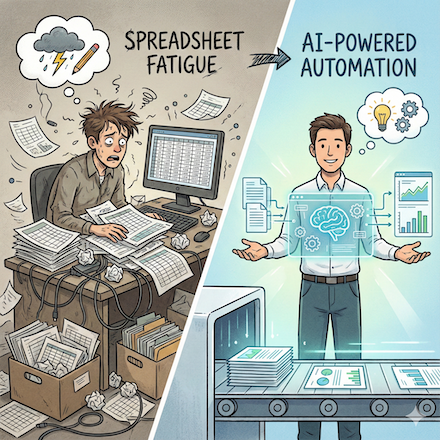
The Friction Tax
Our planning process relies on human glue. We spend 40% of our time managing data instead of making decisions.
- Data Chasing: Endless email/Slack cycles for status updates and capacity checks.
-
Manual
Checks: PMs manually checking compliance against "Definition of Ready". -
Spreadsheet
Tetris: Capacity planning is disconnected from Jira velocity data.
Hours lost annually to manual "Planning Prep"
Result: Optimism Bias obscures strategic reality.
Three Autonomous Layers
We automate roles, not just tasks. The system operates on three distinct horizons.
1. The Strategist
Annual Planning
Intake of L1/L2 Initiatives. Validates against Corporate Strategy, "Anti-Roadmap", and EPTS. Prioritizes against fixed capacity envelopes.
2. The Architect
Quarterly Planning
The "One Intake" Engine. Triages projects, decomposes them into Epics, and fits them into the quarter using capacity math.
3. The Doer
Sprint Execution
Generates User Stories, writes Acceptance Criteria based on Blueprints, and pre-loads Jira Sprints.
The DoR Gatekeeper
We operate on a 1-Year Horizon with Fixed Capacity Envelopes. The goal is rigorous prioritization to maximize value within that capacity.
Gatekeeper Logic:
-
Context
Awareness: Agent is pre-loaded with Corporate Strategy, the "Anti-Roadmap", and our Technology Strategy (EPTS). -
Outcome-Based
Definition
of Ready: Validates meaningful quarterly outcomes. If feature lists are submitted, it accepts them but abstracts up to a strategic level for the roadmap. - Abstraction: Detailed requirements are preserved and automatically passed down to Layer 2 for future decomposition.
The Voice Loop Innovation
We don’t turn away requests from email or Slack – instead, we instantly follow up with a short voice-AI interview at the requester’s convenience.Semantic Mapping & Sizing
Dependency Radar
The AI analyzes the new initiative against the 1-Year Roadmap and EPTS Strategy using semantic similarity.
"Customer 360" initiative implicitly relies on "Data Lake Upgrade" which is scheduled for Q3.
Capacity Sizing
AI estimates T-Shirt sizing (S/M/L/XL) based on previous similar initiatives.
It plots demand against the Fixed Capacity Envelope. If Demand > Capacity, it flags "Surge Capacity" needs immediately for leadership review.
The "One Intake" Engine
This is the engine of the portfolio. It bridges Strategy and Execution through the "One Intake" process.
1. Auto-Triage
Consults "POD Scope Matrix" & "Role Roster" to auto-assign Tech Lead & PM.
Routing Logic:
- Standard: Routes to Portfolio Backlog.
- Complex: Triggers Enterprise Architect consult.
2. Decomposition
Acts as "Junior Solution Architect". Generates Draft Project Backlog (Epics).
PM, Tech Lead, and Biz Lead jointly review the AI draft. They never start from a blank page.
3. Capacity Tetris
Fits Epics into quarter buckets using real Jira velocity.
- Rule: Projects ≤ 3 Quarters. Epics ≤ 1 Quarter.
- Target: ~120% Capacity (Healthy Pressure).
Ready for Dev
The "Doer" ensures the backlog is groomed before the Sprint begins.
Agent Workflow
- User Story Gen: Drafts stories for every Epic using standard format.
- AC Gen: Writes Given/When/Then criteria based on Solution Blueprints.
- Sprint Loading: Pre-loads backlog based on POD's last 3 sprints velocity.
Deep Integration
We don't just "suggest". The Agent has write-access to Jira to create tickets, link dependencies, and populate fields.
Modular Orchestration
No "Black Box" SaaS. We build an orchestration layer over our existing data.
n8n
Nervous System
Connects Apps & Triggers
Gemini 2.5 Pro
Cognitive Engine
2M+ Token Context allows ingesting entire Strategy.
Jira
System of Record
Deep API Integration
Vapi
Interaction Layer
Voice AI
Pilot Economics
Leveraging existing infrastructure (GCP) and consumption-based pricing results in a negligible OpEx. Note: One-time startup costs (e.g., Vapi setup) estimated at < $100.
Cognitive Engine
Gemini 2.5 Pro (Vertex AI)
- Volume: 40 Requests / Qtr
- Load: ~5,500 tokens / req
- Total: ~220k tokens
Orchestration
n8n (Self-Hosted or SaaS)
- Community Ed: $0 License
- Hosting: GCP Cloud Run
- SaaS Option: $20/mo starter
Voice AI
On-Demand Remediation
- Startup: $20 (ID + Credit)
- Volume: ~30 calls / Qtr
- Rate: ~$0.15 / min
The Pilot
We focus solely on Layer 2 (Quarterly Planning). Since Annual Planning is nearly complete, we will optimize the upcoming Q2 Project Intake cycle.
1. Connect
Wire up n8n to the "One Intake" Project Form to listen for Q2 submissions.
2. Deploy
Launch the Triage & Decomposition Agent (Gemini 2.5) to draft backlogs.
3. Measure
Track the reduction in "Planning Prep" time for Tech Leads and PMs.